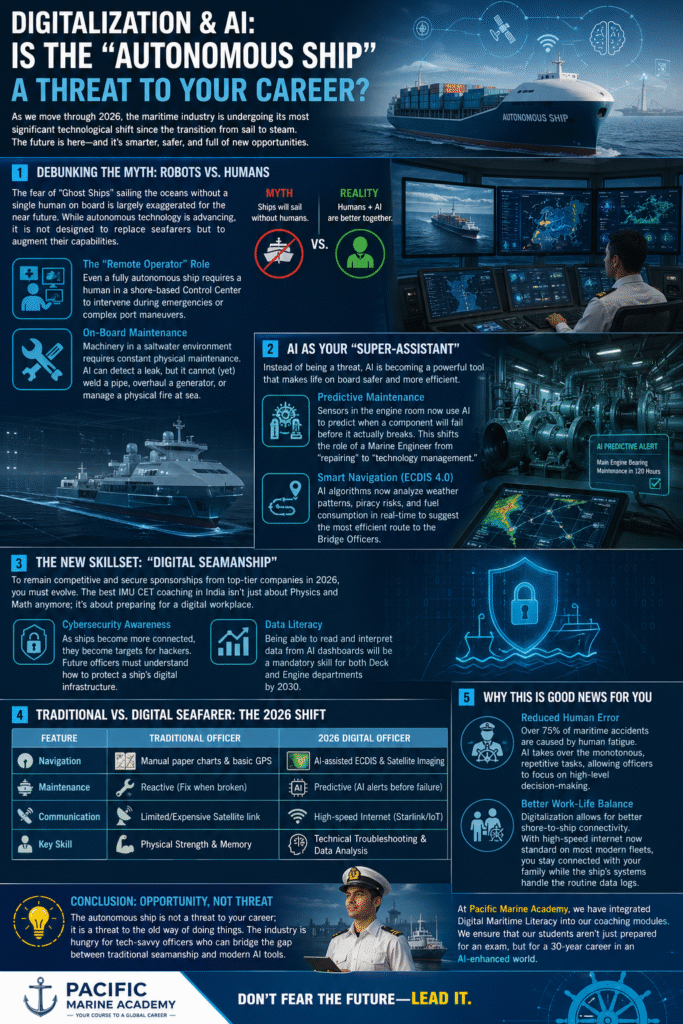
As we move through 2026, the maritime industry is undergoing its most significant technological shift since the transition from sail to steam. With the rise of MASS (Maritime Autonomous Surface Ships) and AI-driven navigation, many aspiring seafarers are asking a critical question: “Will robots take my job before I even reach the rank of Captain?”
As the best IMU CET coaching in India, it is our responsibility to look beyond the headlines and understand how digitalization actually creates a more secure, high-tech, and sustainable career for the next generation of officers.
1. Debunking the Myth: Robots vs. Humans
The fear of “Ghost Ships” sailing the oceans without a single human on board is largely exaggerated for the near future. While autonomous technology is advancing, it is not designed to replace seafarers but to augment their capabilities.
- The “Remote Operator” Role: Even a fully autonomous ship requires a human in a shore-based Control Center to intervene during emergencies or complex port maneuvers.
- On-Board Maintenance: Machinery in a saltwater environment requires constant physical maintenance. AI can detect a leak, but it cannot (yet) weld a pipe, overhaul a generator, or manage a physical fire at sea.
2. AI as Your “Super-Assistant”
Instead of being a threat, AI is becoming a powerful tool that makes life on board safer and more efficient.
- Predictive Maintenance: Sensors in the engine room now use AI to predict when a component will fail before it actually breaks. This shifts the role of a Marine Engineer from “repairing” to “technology management.”
- Smart Navigation (ECDIS 4.0): AI algorithms now analyze weather patterns, piracy risks, and fuel consumption in real-time to suggest the most efficient route to the Bridge Officers.
3. The New Skillset: “Digital Seamanship”
To remain competitive and secure sponsorships from top-tier companies in 2026, you must evolve. The best IMU CET coaching in India isn’t just about Physics and Math anymore; it’s about preparing for a digital workplace.
- Cybersecurity Awareness: As ships become more connected, they become targets for hackers. Future officers must understand how to protect a ship’s digital infrastructure.
- Data Literacy: Being able to read and interpret data from AI dashboards will be a mandatory skill for both Deck and Engine departments by 2030.
Traditional vs. Digital Seafarer: The 2026 Shift
| Feature | Traditional Officer | 2026 Digital Officer |
| Navigation | Manual paper charts & basic GPS | AI-assisted ECDIS & Satellite Imaging |
| Maintenance | Reactive (Fix when broken) | Predictive (AI alerts before failure) |
| Communication | Limited/Expensive Satellite link | High-speed Internet (Starlink/IoT) |
| Key Skill | Physical Strength & Memory | Technical Troubleshooting & Data Analysis |
4. Why This is Good News for You
- Reduced Human Error: Over 75% of maritime accidents are caused by human fatigue. AI takes over the monotonous, repetitive tasks, allowing officers to focus on high-level decision-making.
- Better Work-Life Balance: Digitalization allows for better shore-to-ship connectivity. With high-speed internet now standard on most modern fleets, you stay connected with your family while the ship’s systems handle the routine data logs.
Conclusion: Opportunity, Not Threat
The autonomous ship is not a threat to your career; it is a threat to the old way of doing things. The industry is hungry for tech-savvy officers who can bridge the gap between traditional seamanship and modern AI tools.
At Pacific Marine Academy, we have integrated Digital Maritime Literacy into our coaching modules. We ensure that our students aren’t just prepared for an exam, but for a 30-year career in an AI-enhanced world.
Don’t fear the future—lead it.
Enroll Today in our 2026 Foundation Batch and Take the First Step toward the Captain’s Chair. For more details visit our website https://pacificmarineacademy.com/.